
 Are you ready to help them? Let’s become a volunteers...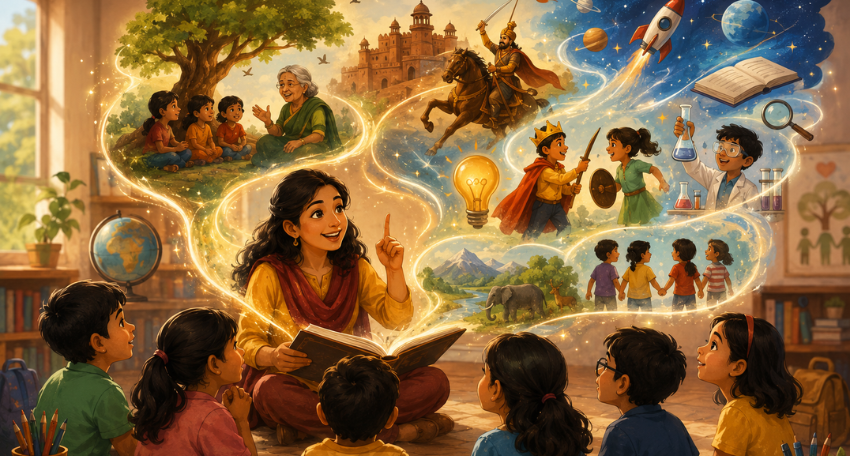
Why Storytelling is Becoming an Essential Part of Education
“Stories are a communal currency of humanity.” — Tahir Shah
Long before the advent of classrooms, textbooks, and digital screens, storytelling served as the primary means for humans to transmit knowledge, culture, and values from one generation to the next. In today’s rapidly changing world, the significance of storytelling is being rediscovered as a powerful educational tool. In fact, the National Education Policy (NEP) 2020 recognizes storytelling as a fundamental method of teaching and learning.
Education is no longer limited to memorizing facts or scoring marks. Modern learning focuses on developing children into empathetic, creative, communicative, and emotionally aware individuals. Storytelling naturally nurtures all these qualities.
Why Storytelling Matters in Education
Children connect with stories instinctively. We have a few concepts engraved in our lives because they were told to us by our grandmas through stories. A concept explained through a story becomes easier to understand, remember, and relate to. Whether it is science, history, language, or moral education, storytelling transforms abstract ideas into meaningful experiences.
For example, teaching honesty through a lecture may not leave a lasting impression, but a story about truth and consequences helps children emotionally connect with the idea. Stories engage imagination, curiosity, and emotions together, making learning deeper and more impactful.
Storytelling also improves:
- Listening and communication skills
- Creative and critical thinking
- Vocabulary and language development
- Emotional intelligence and empathy
- Confidence and self-expression
In classrooms where storytelling is incorporated regularly, children participate more actively and develop stronger social and emotional connections.
Storytelling and the National Education Policy (NEP)
The NEP 2020 strongly emphasizes experiential, interactive, and holistic learning. It encourages schools to move beyond rote learning and adopt creative teaching methods that make education enjoyable and meaningful.
Storytelling has been highlighted as an important pedagogical tool because it helps impart:
- Concepts and subject understanding
- Moral and ethical values
- Life skills and problem-solving abilities
- Cultural awareness and social sensitivity
The policy recognizes that education must prepare children not only academically but also emotionally and socially for the future. Storytelling plays a crucial role in achieving this vision.
How Storytelling Can Be Incorporated in Curriculum
Storytelling can be integrated across subjects and age groups in simple yet effective ways.
In Language Classes
Children can narrate stories, create endings, or enact characters. This strengthens communication and imagination and boosts confidence.
In Science and Mathematics
Concepts can be introduced through situations and characters, making difficult ideas easier to grasp. Try it and see the expressions of the little ones!
In Social Studies and History
Historical events and biographies become more engaging when presented as narratives instead of plain facts. After all, life is a story, isn’t it?
In Value Education
Stories help children understand empathy, kindness, teamwork, resilience, and responsibility in a natural, relatable way.
Schools are also increasingly using storytelling circles, read-aloud sessions, role-play, theatre, and digital storytelling as part of classroom learning. Believe me children look forward to these classes.
Beyond Academics
Storytelling is more than just a teaching method; it serves as a vital connection between knowledge and human interaction. In a time when children are inundated with information yet often lack emotional engagement, stories play a crucial role in fostering compassion, identity, and understanding.
As educators and parents reconsider the purpose of education in the 21st century, storytelling is becoming essential rather than simply an additional activity. After all, the lessons that children remember for a lifetime are often not those taught from a blackboard, but those intricately woven into stories.