
 Are you ready to help them? Let’s become a volunteers...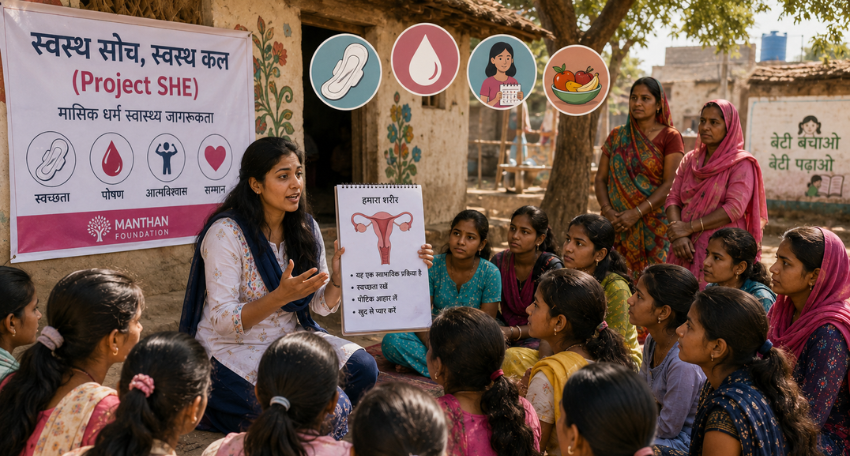
Beyond Whispers: The Urgent Need for Menstrual Hygiene Awareness in Rural India
“Menstruation is not a problem. The silence around it is.”
In many urban areas of India today, conversations about menstrual health are gradually becoming more open and informed. However, in villages and rural communities, menstruation still remains shrouded in silence, misinformation, and stigma. For millions of young girls, menarche, their first period, is met with confusion and fear rather than understanding.
When we at Manthan Foundation began working in villages of Jaunpur district under Project SHE (Sanitary Health Empowerment), we expected to encounter a lack of resources. What we witnessed, however, was a far deeper issue: a lack of awareness.
During one of our awareness sessions, I interacted with adolescent girls who had already started menstruating but knew very little about their own bodies. Many of them did not understand why periods occur, how the body changes during puberty, or the importance of hygiene and nutrition during menstruation. Some even believed that menstruation was an illness. Others had only learned about it through whispers, restrictions, or fear.
The experience was both deeply moving and troubling.
What stood out most was not just the absence of sanitary products, but the absence of conversation. The girls had entered an important biological phase of life without guidance, knowledge, or emotional support. This interaction strengthened our resolve to expand Project SHE beyond menstrual hygiene awareness to a broader conversation about women’s health, nutrition, dignity, and body literacy.
The reality across rural India reflects this concern. According to various national surveys and reports:
- Nearly 23 million girls in India drop out of school annually due to lack of menstrual hygiene management facilities and awareness.
- A significant percentage of women in rural India still rely on unsafe materials such as old cloth, ash, husk, or hay during menstruation.
- Poor menstrual hygiene practices can increase the risk of infections, reproductive health complications, and long-term health issues.
- According to the National Family Health Survey (NFHS), access to hygienic menstrual products remains significantly lower in rural regions compared to urban India.
The issue extends beyond just sanitary pads—it encompasses dignity, education, and health equity.
Menstruation is closely tied to nutrition and overall health. Many girls we met in Jaunpur were unaware that symptoms such as weakness, fatigue, and intense discomfort during their periods could be linked to anemia and poor nutrition. In communities where girls already have limited access to healthcare, the silence surrounding menstrual health further exacerbates their vulnerability.
This is why awareness matters.
When girls are educated about menstruation, they gain confidence. Open discussions within communities help reduce stigma. When schools and families engage in these conversations, girls are empowered to care for their bodies without shame.
Through Project SHE, the Manthan Foundation conducts menstrual health awareness sessions in rural villages, creating safe spaces for dialogue and learning. Our goal is not only to share information but also to normalize conversations about women’s health, ensuring that no girl grows up feeling afraid of her own body.
Change begins with awareness, and awareness starts with conversation. Menstrual health is not just a women’s issue; it is a matter of public health, education, dignity, and equality.